
Retailers are also demanding that home delivery across all forms of retail should be allowed to ensure a level playing field.

'High-value homes are designed and built on slum lands and slums are given residue. They do not have access to free air and live in close proximity of others.'

Data from market research agency Nielsen shows that 152 new players entered the hygiene market in March as the lockdown was implemented to contain the spread of the coronavirus disease. The trend is expected to continue, the agency says, as hygiene and health emerge as key themes.

Most firms operating in the space claim that they have seen at least a two-fold rise in orders as compared to other times.

While FMCG companies were not barred from carrying out their operations during the 21-day lockdown, since most manufacture staples and essential products, capacity utilisation remained poor, owing to the restricted movement of raw materials, finished goods, and labour.

'Clearly, the next few months will be very challenging for industry.' 'We are clearly in a phase where recovery is a dream.'

Top companies reported that despite most of them making staples and essential products, movement of raw material, goods and labour remained restricted, impacting sales.

CREDAI-MCHI, a body of developers in Mumbai, has pegged the drop in sales booking at around 80 per cent in the February-March period this year. This is the second highest fall in residential sales in the past five years, after Q1, 2017, when the decline, due to the note ban, was 37 per cent.

What will happen to the job placement and summer internship plans of India's management and IIT students? Many campuses are stepping in to help students hang on to their placements, in spite of the lockdown.

Overcrowding, unsanitary conditions in Asia's largest slum pose big challenges to containment.

Over the past week, several unusual partnerships among start-ups, traditional businesses and hospitals have been announced, and several more are likely to materialise soon. The trend could see increased importance of gig workers, who are taking considerable risk to deliver goods to people in the time of a pandemic.

News viewership was the biggest gainer during the first full week of lockdown, growing 298 per cent versus the pre-COVID period between January 11 and 31. Ramayana, whose rerun has begun on Doordarshan, was the top-rated show on Saturday and Sunday.

For now, Bounce, Shuttl, Fab Hotels, Instamojo, Zomato, Curefit, and HealthifyMe, among others, are going for salary deductions. Most of the consumer internet start-ups, besides those who are in the grocery delivery, education tech, and video conferencing business, would ultimately lay-off people and cut back salaries.

While some researchers are developing prototypes for ventilators to overcome their shortage, others have teamed up to develop testing kits.
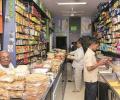
'90 per cent of the food and grocery business is still with the kiranas.' 'If kiranas are not allowed to operate, it becomes a serious issue.'

However, many of these firms were facing an uphill task of convincing the people on the ground to return to work, as many are apprehensive of their safety.

'We are going to be overwhelmed by the need for hospital beds. There are simply not enough beds in government hospitals.' 'We will need a large number of medical professionals and without the private sector's involvement, the government won't be able to expand capacity.'

There is a lot of police action on the ground and even inter-state movement has been stopped, because of which deliveries of essential items via platforms, such as Flipkart, Amazon, Grofers, and Milkbasket, aren't happening. Food-delivery firms -- Swiggy and Zomato -- are facing similar challenges, according to the sources.

Cancellation of at least Rs 3,000-crore worth of business has happened in the past few weeks.

According to a survey by community platform LocalCircles, early-stage start-ups, funding dependent start-ups and many small businesses will soon be fighting for survival as the spurt in coronavirus cases hits them hard.
 © 2025 Rediff.com - Investor Information - Advertise with us - Disclaimer - Privacy Policy - Sitemap - Feedback - About us - Terms of use - Grievances